
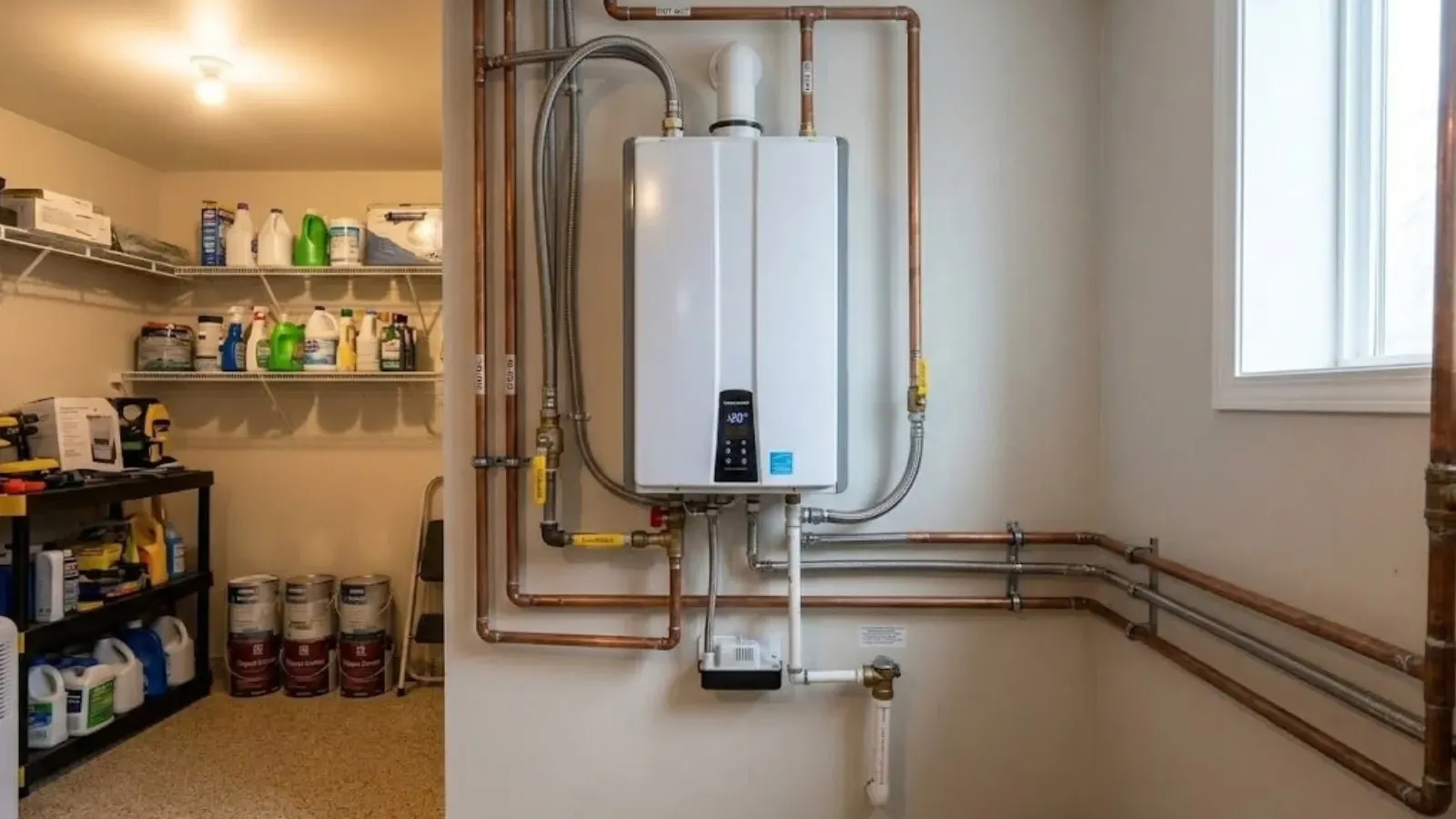
Why a tankless heater needs flushing
Minerals in the water bake onto the inside of the heat exchanger and narrow the passages. The unit then works harder, shows error codes or delivers less hot water.
Manufacturers call for periodic flushing, and the right interval depends on your water and how heavily you use hot water. A unit that fires on and off, runs cool or shows a scale code is overdue.
What you need
- A small submersible pump and two hoses that fit the service ports.
- A bucket large enough to hold several gallons of descaling solution.
- White vinegar or a descaler approved for your unit by the manufacturer.
- A wrench and a towel for the service valves.
- The owner's manual for the shutdown and restart steps.
The general steps
| Step | What to do | Why |
|---|---|---|
| 1 | Turn off power or gas to the unit | Prevents firing without water |
| 2 | Close the cold and hot service valves | Isolates the heat exchanger |
| 3 | Connect hoses to the service ports and the pump | Creates a loop through the unit |
| 4 | Run descaling solution through the loop for the time the manufacturer lists | Dissolves scale |
| 5 | Drain the solution and rinse with clean water | Removes loosened scale |
| 6 | Clean the inlet filter screen | A clogged screen cuts flow |
| 7 | Open the valves, purge air and restore power or gas | Returns the unit to service |
Prefer to leave it to a plumber?
Call and give us the make and model. We flush and descale tankless heaters.
When to hand the job to a plumber
DIY is reasonable when
- The unit has service ports and you have the manual
- It is electric or you are comfortable with gas shutoff
- There are no error codes or leaks
Call a plumber when
- The unit is gas and you smell gas
- Service ports are missing or seized
- It shows persistent error codes
- You find leaks or heavy scale
Our tankless water heater service includes flushing, and a unit that has failed may be a case for water heater repair.
Mistakes to avoid
If anything looks wrong, such as a leak, persistent error code or a smell of gas, stop and call a plumber. A flush that goes wrong costs more to fix than a visit.
- Skipping the power or gas shutoff before connecting hoses.
- Using a cleaner the manufacturer does not approve, which can damage seals and parts.
- Forgetting to clean the inlet filter screen, which can limit flow after a flush.
- Leaving air in the lines, which can trigger error codes at restart.
- Ignoring leaks at the service ports afterward.
What a flush does not fix
Flushing removes scale, and it does not repair a failed sensor, a cracked heat exchanger or a venting problem. A unit that still runs cold or shows codes after a clean flush needs a diagnosis.
It also does not replace a water treatment plan. If your tap shows scale quickly, a softener or a scale filter can protect the unit, and a plumber can advise on what suits your water.
Signs the heat exchanger is scaling up
Any of these is a reason to check the manual and schedule a flush. Waiting lets scale harden, and heavy scale is harder to remove.
- Hot water output drops even though the unit fires.
- The unit shows an error code that mentions flow, temperature or scale.
- Water temperature swings between hot and lukewarm.
- The unit clicks on and off in short cycles.
- You see white or tan crust at faucet aerators.
What a service visit includes
A service visit usually isolates the unit, runs a descaling solution through the heat exchanger and flushes it with clean water. The technician also cleans the inlet filter and checks the vent, the burner and the error log.
Ask for a note of what was found. Heavy scale on the first flush tells you to shorten the interval, and a clean exchanger tells you the schedule is working.
One more thing to check
Check the manual for the flush kit the maker recommends. Some units have service valves built in, and others need them added before a flush is possible.
If your water is hard, a flush every year is a common starting point, and a softener upstream can lengthen the interval. Your own water decides the schedule more than any general rule does.
Write the date of each flush on a label near the unit. A visible record helps you and any later technician judge whether the schedule suits your water.
Also keep the descaling solution and the pump hoses together in a labelled bag so the next flush starts without a search.
Wilsonville note: how often should you flush?
Wilsonville's annual water quality report does not list a hardness figure, so the right interval depends on what your own tap shows. Test your tap or ask the utility for its latest report, and flush more often if you see scale on fixtures.
The city's primary supply comes from the Willamette River Water Treatment Plant, and its pH is raised to between 7.4 and 8.0. That does not tell you how much scale a heater will see, so watch the unit for error codes and falling flow. Customers in Sherwood draw from the same plant and can use the same approach.
Frequently asked questions
You flush the heat exchanger through the service ports with descaling solution and rinse it out, following the manufacturer's steps.
Follow your manufacturer's schedule, and flush sooner if the water is hard or the unit shows scale codes.
Many manufacturers list white vinegar or an approved descaler. Check yours before using anything.
It involves hot water, power or gas and hoses. If you are not comfortable, call a plumber.
It depends on your tap water. The city's report does not list hardness, so test your tap and watch for error codes and falling flow.