
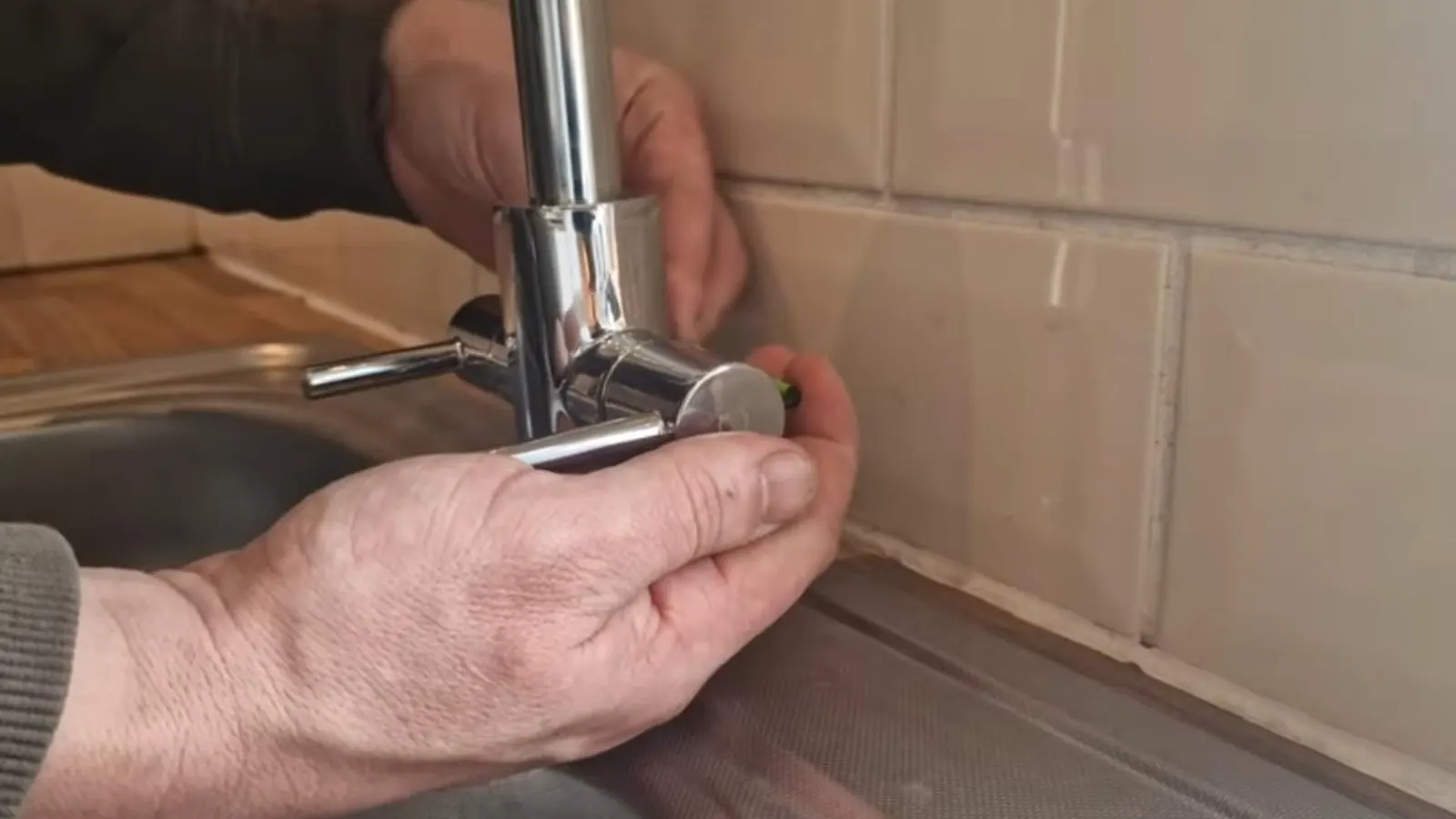
Which kind of faucet do you have?
Knowing the type tells you which part wears out, and the brand name on the handle or spout helps you find the right cartridge or kit.
| Type | How to tell | Usual drip cause |
|---|---|---|
| Compression | Two handles that you tighten against a stop | Worn rubber washer or seat |
| Cartridge | One or two handles that move smoothly | Worn cartridge or O-ring |
| Ball | Single handle over a rounded cap | Worn seals and springs |
| Ceramic disc | Single lever with a smooth, quiet motion | Worn seals or a cracked disc |
A basic cartridge faucet repair, step by step
If the shutoff valves will not close, stop and call a plumber. Forcing a stuck valve can snap the stem and turn a drip into a flood.
- Turn off the shutoff valves under the sink, then open the faucet to relieve pressure.
- Plug the drain so small screws and parts cannot fall in.
- Pry off the handle cap, remove the handle screw and lift off the handle.
- Pull out the retaining clip or nut and lift out the cartridge, noting its position.
- Replace the cartridge and O-rings with matching parts and reassemble in reverse order.
- Turn the water on slowly and check for leaks at the base and handle.
Faucet will not shut off or valves are stuck?
Close the main if needed and call. The 24/7 line is open.
Repair or replace the faucet
Repair when
- A part is available and the finish is good
- The drip started recently
- The faucet is a style you like
Replace when
- The faucet is corroded or pitted
- Parts are discontinued
- You want a different style or a water-saving model
Our faucet and sink repair visit covers both, and a leak behind the wall may need leak detection.
Tools and parts to gather first
Take the old part with you to the store, since cartridges that look alike can differ by a few millimeters. A mismatch means the drip comes back or the handle will not seat.
- An adjustable wrench and a screwdriver set, with a small hex key for some handles.
- Plumber's grease and a rag to protect the finish.
- A replacement cartridge or repair kit that matches the brand and model.
- A bucket or towel under the sink, and a stopper or rag for the drain.
- A phone photo of each step, so reassembly is easy.
Mistakes that turn a drip into a bigger job
Overtightening is the most common one. A handle screw or packing nut cranked too hard can crack a ceramic disc or strip brass threads, and then the faucet is past repair.
The second is forcing a corroded valve. If the shutoff under the sink will not budge, stop, because a snapped stem means you cannot shut off the water to that sink at all.
The third is replacing a part without asking why it failed. A drip that returns within months often points to high pressure, grit in the lines after construction or hard water, and a plumber can test for those.
How to tell the drip is fixed
After reassembly, open the water slowly and let the faucet run for a minute to clear air. Turn it off and watch the spout for a few minutes, and check the base of the faucet and the supply lines for moisture.
Dry the area with a towel and look again after an hour. A new drip that appears at the base means a seal is not seated, and one that returns at the spout means the cartridge or seat is still worn.
A small water-saving upgrade
While the faucet is apart, consider a new aerator. Aerators mix air into the stream, which feels like strong flow with less water, and low-flow models are common.
Clean the aerator if flow has dropped. Unscrew it, soak it in vinegar and brush away mineral buildup before putting it back.
Why a small drip is worth fixing
A faucet that drips once a second wastes thousands of gallons over a year, and the constant moisture stains the basin and wears the seat faster. The part that fails is usually a few dollars of rubber or ceramic.
If you open the faucet and find a corroded body or a seat that is pitted beyond cleaning, replacing the faucet is often the better choice than another repair.
One more thing to check
Before you start, plug the drain with a rag or a stopper so a small screw cannot fall in. Lay out the parts in the order you remove them and take a photo at each step.
Bring the old cartridge or washer to the hardware store so you can match it. Faucets from different makers look alike and are not interchangeable.
Wilsonville note: pressure can cause drips
High house pressure makes faucets drip and wears out cartridges early. Wilsonville's utility billing FAQ says the pressure reducing valve usually sits after the meter, often in a plastic or concrete box between the meter and the house, so a drip that returns after repair is a reason to test pressure.
The same FAQ says that for low pressure at all fixtures the city will do a leak check on request. A drip is local, though, so a single faucet is usually a plumbing repair and not a utility matter. Customers in Sherwood and across our service area get the same pressure advice.
Frequently asked questions
A worn washer, cartridge or O-ring lets water past the seal. High water pressure can make parts wear faster.
The EPA says a faucet dripping once per second can waste more than 3,000 gallons a year.
Often yes, with matching parts and the water shut off. If the shutoff valves will not close, stop and call a plumber.
A cartridge replacement is often a short job, and a corroded or hard-to-reach faucet takes longer.
It can. The city says the pressure reducing valve usually sits after the meter, and a plumber can test pressure and adjust or replace the valve.