
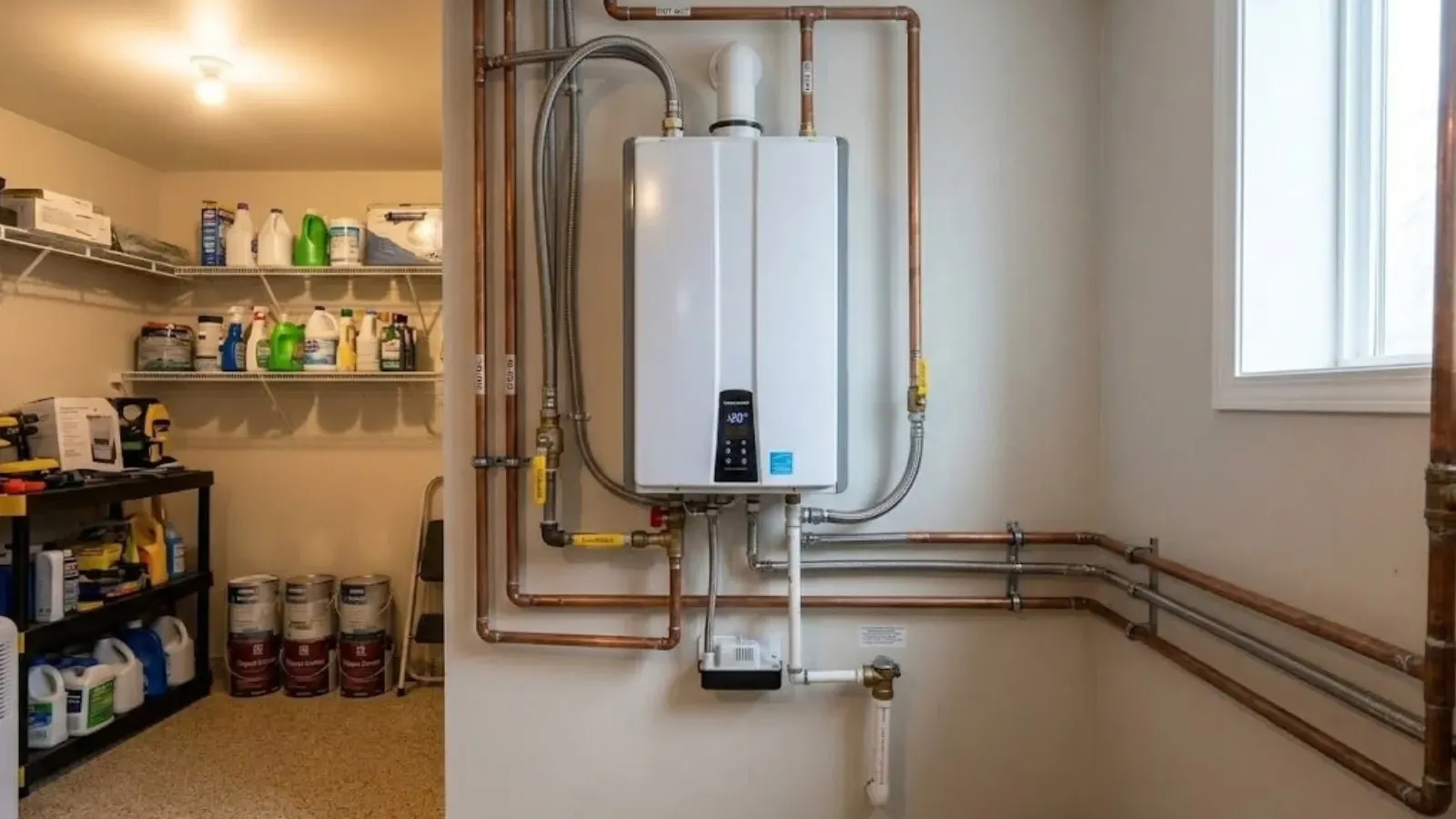
Why you wait for hot water at all
A tankless unit heats water only when a tap opens. The delay comes from the cold water sitting in the pipe between the heater and the fixture, and the longer the run, the longer the wait.
A recirculating system keeps hot water moving or ready. It will not make the heater faster, but it shortens the wait at distant fixtures and wastes less water down the drain while you stand there.
The three common setups
Every setup also needs a way to control the pump. A timer, a motion or push-button activation and a temperature sensor each trade comfort for energy use, and a pump that runs all day increases heat loss from the pipes.
| Setup | How it works | Trade-offs |
|---|---|---|
| Dedicated return line | A separate pipe carries water back from the farthest fixture to the heater | Best performance, but needs a return pipe, which is easiest in new construction or a remodel |
| Crossover valve at the farthest fixture | A small valve connects hot and cold lines so the pump pushes water through the cold pipe | No new pipe, but the cold tap runs warm until the loop cools |
| Built-in recirculation in the heater | Some tankless units include a pump and recirculation mode | Check the manufacturer's requirements and whether a return path is still needed |
What to check before adding a pump
- Ask whether your heater model is rated for recirculation, since some require a specific pump or a built-in feature.
- Check whether a return line already exists or whether the pipe layout allows a crossover valve.
- Measure how long the wait really is, because a short run may not justify a pump.
- Check noise, since a pump near a bedroom wall can be heard.
- Plan descaling. More flow cycles through the heat exchanger means scale matters sooner in hard water.
Want hot water faster at the far tap?
Call and describe the layout. A technician can say which setup fits.
Is a recirculating pump worth it?
Where it helps
- A long pipe run to the primary bath
- Households that wait a long time at one tap
- Homes that waste water while waiting
Where it may not
- A short run to a nearby bathroom
- A pump with no timer that runs all day
- A heater not rated for recirculation
Installation details and sizing are part of tankless water heater service, and a new system with a return line is easiest to plan as part of water heater installation.
Controls that decide the energy cost
A pump that runs around the clock keeps pipes warm and loses heat through the walls the whole time. Most homes do better with a timer matched to the household, such as morning and evening, or with a push button or motion trigger that starts the pump only when someone wants hot water.
A temperature sensor on the return line stops the pump once the loop is warm, and that cuts running time further. Ask the installer which control suits your routine, and review the setting after a month.
If you are weighing a whole new system, a water heater replacement visit is the moment to plan a return line.
How to decide in three questions
If the wait is short and no return line exists, you may be better off without a pump. If the wait is long and the layout supports a return line, a pump pays back in comfort and saved water.
- How long do you wait for hot water at the farthest fixture today?
- Is there a return line, or can one be added without opening many walls?
- Does your heater model support recirculation, and what control will you use?
Running the pump sensibly
A pump that runs all day heats pipes that nobody is using. A timer, a temperature sensor or a push button runs it only when hot water is needed, which saves energy and wear.
Insulating the hot water pipes helps as well, because the water stays warm longer between uses. Ask the installer which control suits your household.
One more thing to check
Some tankless models include a small internal buffer or a built-in recirculation mode. Others need an outside pump, a return line or a dedicated crossover valve.
Check your model before you buy a pump. A mismatch between the heater and the pump can void a warranty or cause noisy, uneven operation.
Wilsonville note: pressure and water quality
Tankless heaters need enough flow to fire, and house pressure matters. Wilsonville's utility billing FAQ says the pressure reducing valve usually sits after the meter, often in a plastic or concrete box between the meter and the house, so find it and ask a plumber to test pressure before you blame the heater.
The city's annual water quality report does not list a hardness figure. If you want to know how often the heat exchanger needs descaling, test your tap or ask the utility for its latest report, because scale is the usual reason a tankless unit loses flow over time. Our Sherwood customers draw from the same Willamette River plant, so the same advice applies there.
Frequently asked questions
It can, if it runs all day. A timer or a push-button activation limits the running time and the heat lost from the pipes.
Often, if the heater is rated for it and a return path or crossover valve is possible. Check the manufacturer's guidance first.
A crossover valve lets hot water flow through the cold line, so the cold tap runs warm until the loop cools down. A dedicated return line avoids this.
More cycles can increase scale buildup in hard water. Regular descaling keeps the heat exchanger in good shape.
A gauge on an outdoor spigot reads house pressure. The city says the pressure reducing valve usually sits after the meter, so a plumber can test it and adjust or replace the valve.