
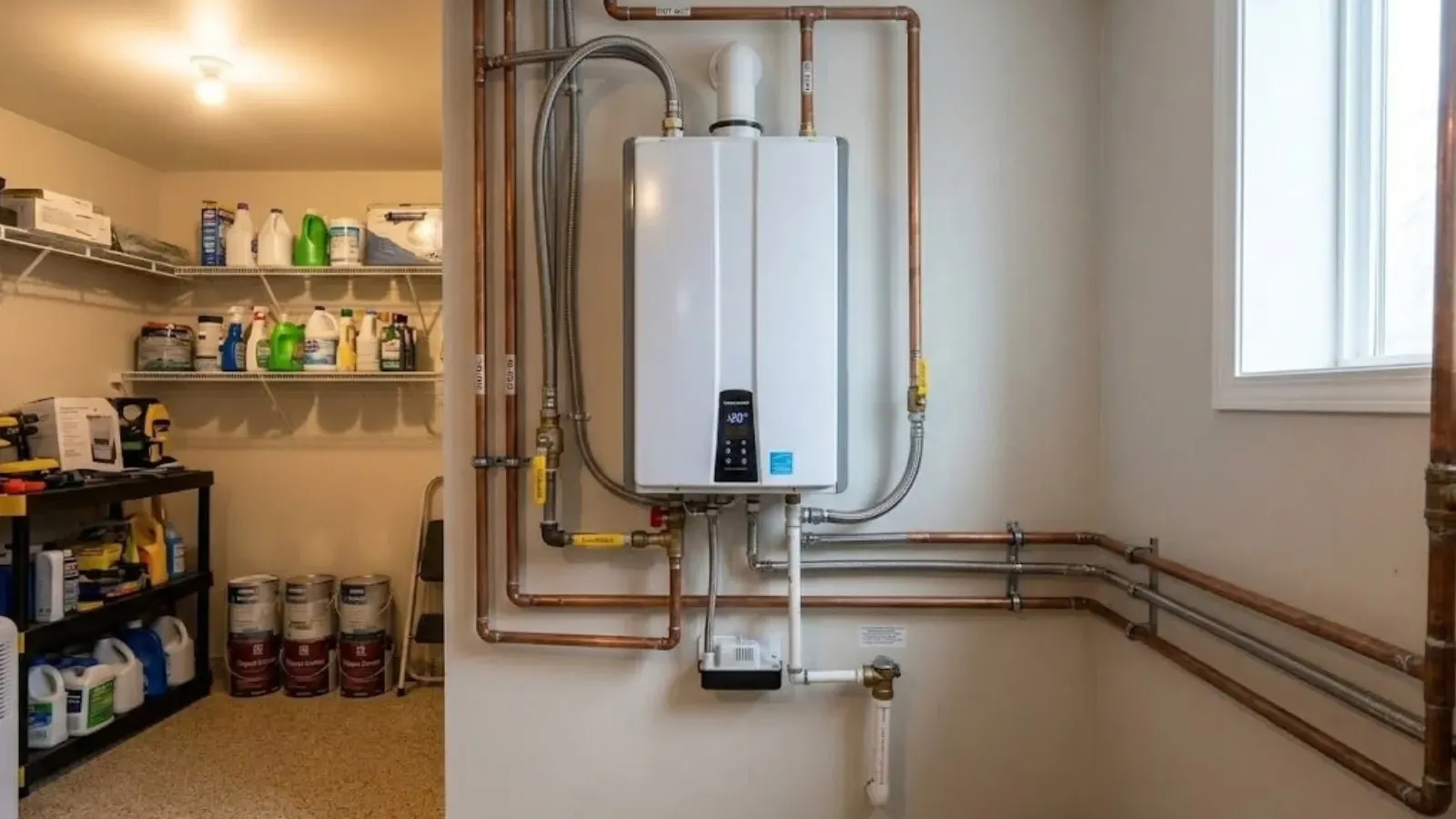
What drives the price
| Factor | Why it matters | Question to ask |
|---|---|---|
| Unit type and capacity | Larger flow rates cost more | How many fixtures can run at once? |
| Gas line size | Many tankless units need a larger gas line than a tank | Does the gas line need upgrading? |
| Venting | Special venting runs add materials and labor | Where will it vent and how far? |
| Condensate drain | High-efficiency units produce condensate | Where does it drain? |
| Electrical | Units need power for controls | Is there an outlet nearby? |
| Relocation | Moving from a closet to a wall changes everything | Is the location changing? |
| Permit | Some water heater work needs a permit | Who pulls it? |
Tank versus tankless: the scope difference
A tank swap usually involves
- Disconnecting and removing the old tank
- New connections and safety valves
- Venting that already exists
A tankless install often adds
- A larger gas line or new electrical work
- New venting and a condensate drain
- A wall mount and sometimes a recirculation setup
Want a clear price for a tankless install?
Call and describe the home. A technician gives a clear price before work starts.
What a good quote includes
- The unit, with its model and capacity.
- Gas line, venting, condensate and electrical work listed separately.
- Permit and who pulls it.
- Any recirculation pump or valves.
- A plan for descaling and the interval the manufacturer recommends.
Is it worth the cost?
Tankless units can last a long time and give endless hot water, and the price premium takes years to recover in lower running costs for many households. The honest answer depends on how much hot water you use and what your gas line can support.
Our tankless water heater page explains the work, and a tank swap is described under water heater replacement.
Running cost versus install cost
A tankless heater heats water only when you use it, so it avoids the standby heat a tank loses. That can lower running costs, but the saving takes time to offset the larger installation.
Households that use a lot of hot water at once, or want endless hot water for long showers, get more value from the extra capacity. A small household with a short run to the bathroom gets less.
How to compare quotes
A quote that looks cheap but leaves out venting or a gas upgrade is not a lower price, because the work is only pushed to a later bill.
- Make sure each quote lists the same unit capacity and the same scope.
- Check that gas line, venting and condensate work are priced, not left as extras.
- Compare permit arrangements and who handles inspection.
- Ask about the warranty on the unit and on the installation.
- Ask for the recommended flush interval, since scale protection is part of the long-term cost.
Questions to ask about the gas line
A tankless unit can draw much more gas at full fire than a tank, and a line that served a tank may be too small. Ask the installer to size the gas line for the unit and for the other appliances on it.
If the answer is a new line, ask how long the run is and who handles the work. Gas work is not a place to cut corners, and the line should be tested before use.
Items that show up late in a project
- A gas meter that cannot supply the larger flow without a utility upgrade.
- Venting that has to cross a finished ceiling or an exterior wall.
- Old shutoff valves or pipe at the connection that must be replaced.
- A permit or inspection step that adds days to the schedule.
- A recirculation pump or return line that the household wanted after all.
Comparing quotes fairly
Ask each installer to list the same items: the unit, the venting, the gas line, the permit, the disposal of the old tank and the warranty terms. A quote that leaves one of them out is not a lower price, only an incomplete one.
Ask what happens if the work uncovers a problem. A clear answer in writing beats a verbal promise when something unexpected turns up behind the wall.
One more thing to check
Think about the whole life of the unit and not only the install. Tankless units often last longer than tanks, but they need a flush now and then and a repair can cost more when a part fails.
Ask the installer what service they recommend and how often. A plan for upkeep belongs in the conversation about price.
If you are replacing a tank, ask whether the old drain pan, shutoff valves and discharge pipe will be updated at the same time.
Wilsonville note: permits, space and venting
Permit rules differ by city. Sherwood's building page says permits are required to replace water heaters, and Wilsonville's portal page does not say, so ask the Wilsonville building division before you plan a swap.
Attached homes in Villebois and newer subdivisions in Frog Pond may have venting rules set by a builder or HOA, so ask before choosing a wall for the unit. Tankless units also need enough flow and pressure, and the city's billing FAQ says the pressure reducing valve usually sits after the meter, so a plumber can test it during the quote. We also serve Sherwood.
Frequently asked questions
Gas line upgrades, special venting, a condensate drain and electrical work add to the unit price.
Often yes, since tankless units draw more gas at once. A technician checks the line before quoting.
It depends on your hot water use and the install scope. The savings in running cost take years to recover for many homes.
Longer than a tank swap when gas, venting and electrical work are involved. A technician gives an estimate with the price.
The city's portal page does not say, so ask the Wilsonville building division. In Sherwood, replacing a water heater needs a permit.